

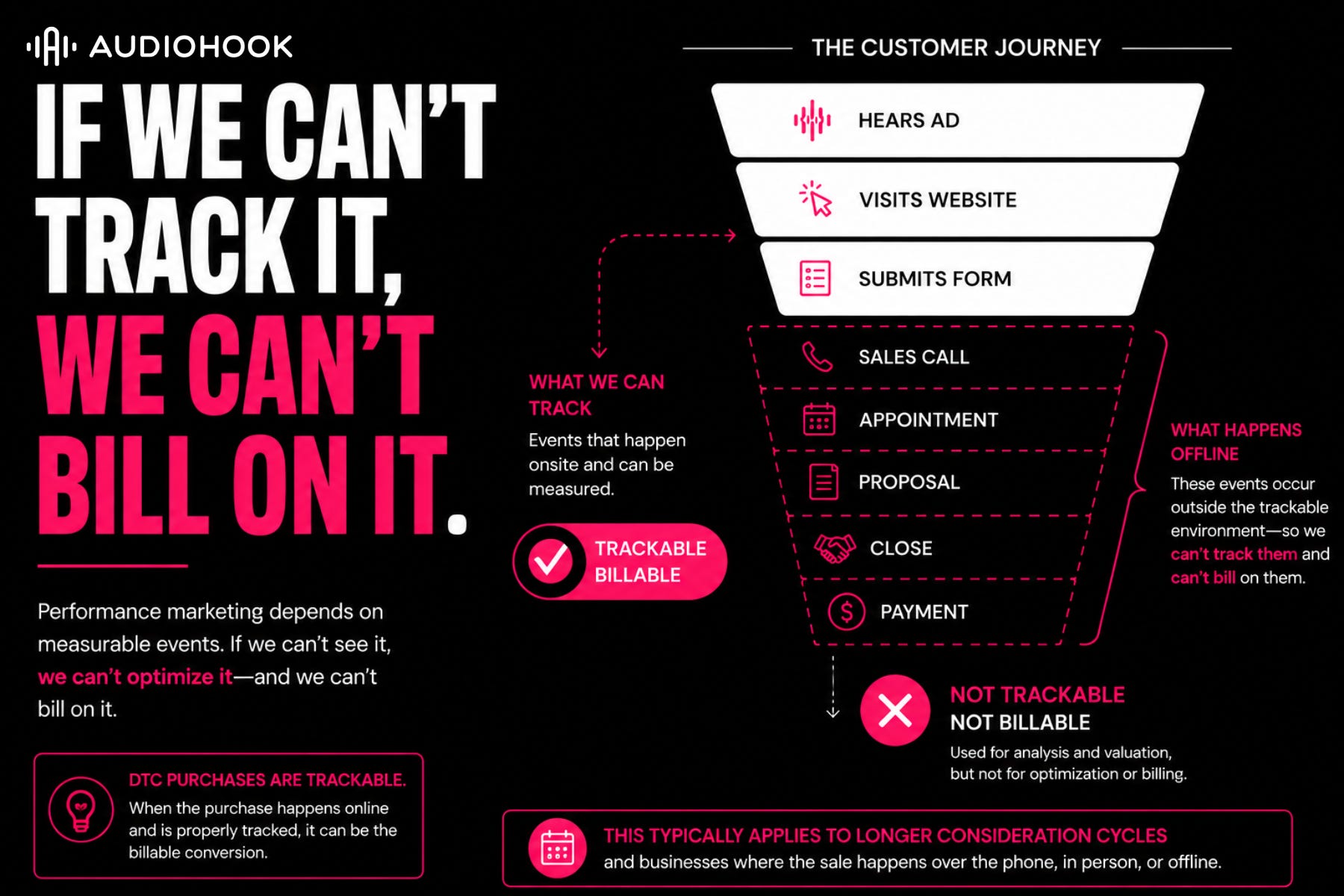
One of the questions we occasionally get from prospective partners is:
“Why can’t we make the final sale our billable conversion event?”
Sometimes it’s a funded loan. Sometimes it’s a signed home improvement contract. Sometimes it’s an appointment that eventually turns into a customer.
From the brand’s perspective, the logic makes sense. That is ultimately the outcome they care about.
But at Audiohook, our rule is simple:
If we can’t independently track it, we can’t treat it as the billable conversion event.
This Usually Isn’t an Issue for DTC
For most traditional DTC ecommerce brands, the purchase is both the end of the funnel and a trackable digital event.
Someone hears an Audiohook ad, visits the website, and makes a purchase. Assuming tracking is properly implemented, we can see that purchase happen, optimize toward it, validate it, and use it as the billable conversion.
The challenge arises when the digital journey ends before the actual sale does.
This is particularly common with longer-consideration purchases and businesses where the ultimate transaction happens over the phone, in person, through a salesperson, or elsewhere offline.
Consider a home services company.
Someone hears an Audiohook ad and submits a form requesting a roofing estimate. From there, the company may call the lead, schedule an appointment, visit the home, prepare an estimate, follow up, get a contract signed, complete the project, and finally collect payment.
The completed project is the outcome the business ultimately cares about. But the form submission may be the last event Audiohook can directly track. Everything afterward happens inside the advertiser’s sales process.
The issue isn’t how far down the funnel the event occurs. The issue is whether we can track it when it happens.
Why Trackability Matters
The conversion event isn’t just how we determine billing. It’s also the feedback our system uses to optimize the campaign.
Imagine 100 people submit lead forms and ten eventually become customers.
If we can see the 100 leads but only the advertiser knows which ten ultimately closed, our system can’t learn from that distinction. We can’t identify which audiences, placements, or strategies produced the highest-quality customers instead of simply the most leads.
A spreadsheet sent later doesn’t create the same optimization feedback loop.
It also creates a fundamental billing problem.
If Audiohook gets paid for every funded loan, but the funded loan happens entirely inside the advertiser’s systems, we would have to rely on the advertiser to tell us how many conversions occurred and, effectively, how much they owe us.
A performance partnership should have an objective, observable way for both parties to determine what happened.
Longer Consideration Cycles Compound the Problem
This becomes even more difficult when weeks or months separate the trackable digital action from the eventual sale.
Someone looking for a loan might submit a form, compare providers, ignore several calls, reconsider weeks later, and finally complete the process over the phone.
We discussed exactly this scenario internally: someone could submit a form after hearing an Audiohook ad but not actually engage with the lender until a month and a half later. Once that journey moves outside the environment we can track, we can’t reliably use that eventual outcome for campaign optimization or billing.
That’s why this issue most commonly applies to businesses with long consideration cycles and sales processes that ultimately close in person or over the phone, rather than traditional ecommerce.
The Final Outcome Still Matters
None of this means we don’t care what happens farther down the funnel.
Quite the opposite.
Downstream conversion rates, customer value, revenue, funded accounts, completed sales, and LTV are critical to determining whether a campaign makes economic sense.
If a business knows that 20% of qualified applications ultimately become customers and knows what those customers are worth, we can use those economics to determine what a trackable application is worth.
In other words:
A downstream outcome can determine the value of the billable conversion without being the billable conversion itself.
And sometimes the deeper event actually is trackable.
Certain financial products, for example, may allow someone to apply, receive approval, open an account, and complete the desired action entirely online. If that final event can be reliably captured through tracking, it may work perfectly well as the billable conversion.
Trackability Isn’t a Technicality
Audiohook makes a meaningful investment in every advertiser we partner with. Our ability to protect and optimize that investment depends on having reliable conversion signals.
For a DTC advertiser where an online purchase represents the end of the funnel, that’s straightforward.
For a business where the website is only the beginning of a months-long sales process that ultimately closes over the phone or offline, we need to identify the deepest meaningful event we can reliably track and structure the campaign economics around it.
We still want to understand everything that happens afterward. We still care whether those leads become customers and whether those customers generate meaningful value.
But the event we optimize toward and bill against has to be observable.
If we can track the final conversion, we can absolutely use it.
If we can’t track it, we can’t bill on it.