
How Audiohook Handles Duplicate Attribution in a Multi-Channel World

One of the most common and important questions we hear from brands is:
“How do you handle duplicate attribution?”
It’s a fair question. And it gets to the heart of one of the biggest challenges in modern marketing measurement.
Let’s unpack it.
The Reality: Overlap Is Inevitable
In today’s ecosystem, customers don’t convert in a straight line.
Someone might:
Hear an audio ad on a podcast
Later see a paid social ad
Then search for the brand
And finally convert through an affiliate link
So when marketers ask about “duplicate attribution,” what they’re really asking is:
“How do we avoid paying multiple channels for the same outcome?”
Here’s the honest answer:
In a multi-touch, multi-channel world, some level of attribution overlap is unavoidable.
Especially in audio, where there is no click.
Why Audio Is Different
Audio is a clickless medium.
There’s no link to click, no immediate signal to capture. Instead, audio influences behavior in ways that are often:
Delayed
Indirect
Multi-touch
That’s why traditional models like last-click attribution fall short. They tend to give credit to the final interaction, not the influential one.
And that’s where most of the confusion around “duplicate attribution” comes from.
What We Don’t Do
At Audiohook, we do not:
Claim every conversion that happens after someone hears an ad
Bill on simple IP matches alone
Use “exposure = credit” logic
An IP match only tells us that we were part of the journey. It does not prove we caused the outcome.
What We Do Instead
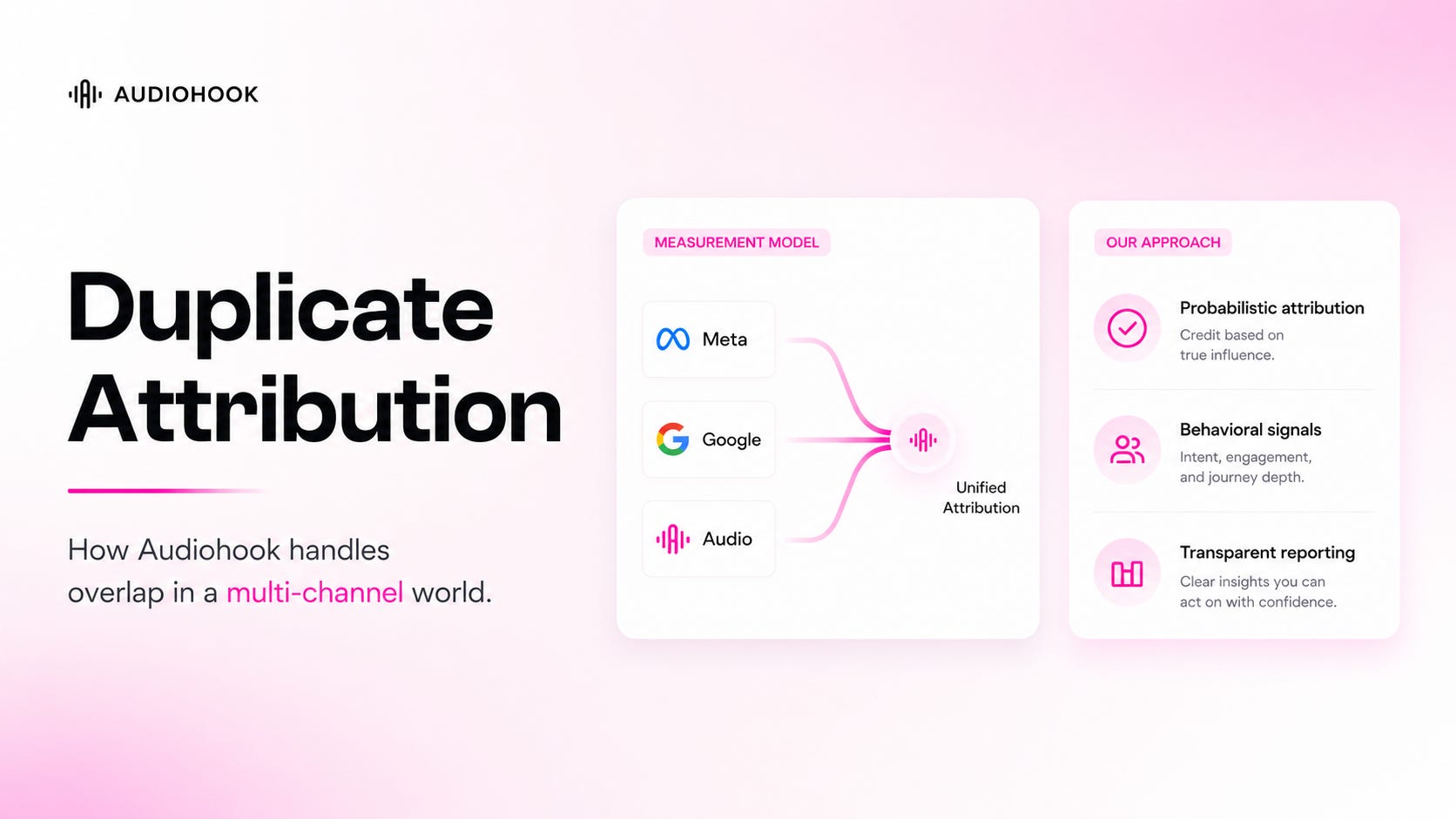
We’ve built our attribution model specifically to solve this problem.
When a conversion occurs, our system evaluates multiple signals, including:
Timing between ad exposure and conversion
Frequency of exposure
Behavioral patterns
Broader journey context
From there, we determine whether Audiohook was the most likely driver of that conversion.
We only claim and bill on conversions that meet that threshold.
Not all matches. Not all overlaps.
Only the ones with the highest probability of influence.
What About Affiliate and Last-Click Channels?
This is where the question gets more nuanced.
If a user:
Hears an Audiohook ad
Then later clicks an affiliate link
And converts
The affiliate platform will typically assign last-click credit.
That does not automatically mean Audiohook also claims that conversion.
Our model evaluates whether:
The affiliate was the true driver, or
Audio was the decisive influence earlier in the journey
If the data indicates another channel was the primary driver, we don’t claim it.
So… Is There Ever Overlap?
Yes. And it’s important to be transparent about that.
Because:
Affiliate platforms are built on last-click
Audio is a non-click channel
And different systems measure influence differently
There can be cases where multiple systems assign credit to the same order.
But here’s the key distinction:
We are not trying to maximize credit. We are trying to isolate incremental impact.
The Real Question: Incrementality
The better question isn’t:
“Are we double paying?”
It’s:
“Are we paying for results that would not have happened otherwise?”
That’s where Audiohook focuses.
Our attribution model is designed to identify:
Conversions that were truly influenced by audio
Not just correlated with it
And we reinforce that with incrementality testing, which measures actual lift against a control group.
Built for Accountability
Transparency matters.
That’s why every conversion we claim is:
Visible at the order level
Demonstrated with individual order details
Supported by journey data
You can see exactly what we’re billing for and why.
The Bottom Line
Duplicate attribution isn’t something you can fully eliminate in a multi-channel world.
But you can design a system that:
Minimizes over-crediting
Prioritizes true influence
And focuses on incremental outcomes
That’s exactly what we’ve built.
Audio shouldn’t be a black box.
And attribution shouldn’t be a guessing game.
It should be measurable, transparent, and grounded in real impact.
If you’re thinking about how audio fits into your broader marketing mix, or want to go deeper on attribution and incrementality, we’re always happy to talk.
Because the goal isn’t just to run ads.
It’s to prove what actually works.